Blog
Cerca un articolo
FPV Drone Laws & Registration USA (2025): TRUST, Remote ID, FAA Rules | HobbyKing
RC Black Friday Buying Guide 2026: What to Buy & How to Save
Battery
LiPo Battery Voltage Chart (Per Cell): 3.7V vs 4.2V vs 3.5V
Battery
LiPo Battery Voltage Chart (Per Cell): 3.7V vs 4.2V vs 3.5V
LiPo Battery Voltage Chart (Per Cell): 3.7V vs 4.2V vs 3.5V
Your OSD just flashed 3.5V per cell.
Maybe it happened right after a punch-out and you saw it dip to 3.3V for a split second. Or you landed, picked up the pack, and it’s sitting around 3.5V/cell. Either way, you’re not thinking “interesting battery chemistry”… you’re thinking: Do I keep going? Do I bring it in? Did I just hurt this pack?
This guide is built for that exact moment. You’ll learn how to read voltage the way real hobbyists do (under load vs rebound), plus what to do if you suspect overcharge or over-discharge.
The 30-Second Takeaway
- 4.2V/cell = full (standard LiPo; quick early drop is normal)
- 3.7V/cell = nominal label (not a reliable “battery %”)
- 3.5V/cell = late-pack warning only after you check rebound
- 3.2–3.3V/cell (rebound/resting) = practical stop line if you want packs to last
- ~3.0V/cell = absolute floor (not a target)
- Storage = 3.8–3.85V/cell when you’re done for the day
The 20-Second Decision Flow (What to Do When Voltage Looks Scary)
In-flight (or mid-run) you’re not measuring a pack like a lab. You’re making a call with imperfect signals. This is the simple loop that keeps packs alive.
Step 1 — Don’t judge the dip.
Under-load dips can be ugly (3.5, 3.4, even 3.3). That’s often sag, not instant pack damage.
Step 2 — Back off for ~2 seconds.
Level out, cruise, slow pass, or gentle throttle. Give the pack a calm moment.
Step 3 — Read the rebound (the useful number).
- Rebound ≥ ~3.6–3.7V/cell: you still have room, but it’s time to start thinking “wrap it up soon.”
- Rebound ~3.3–3.5V/cell: normal end-of-run zone. Finish calmly (no more big punches).
- Rebound ≤ ~3.2–3.3V/cell: you’re at the low end. Land/stop now to avoid dragging a weak cell too low.
Clarification: those thresholds are about when to stop discharging (using the pack) — not “stop charging.” Charging decisions come after cooling and a quick per-cell check.
Voltage Under Load: When Is It Normal Sag, and When Is It Time to Land?
This is where a lot of LiPo confusion starts. A pilot sees 3.5V per cell on the OSD, a car suddenly feels flat, or a boat still looks fast but clearly has less punch than a minute ago. The question usually is not “what is nominal voltage?” It’s: Do I keep going, or is this where I should stop before I hurt the pack?
The key is this: under-load voltage and settled voltage are not the same thing. A LiPo can dip hard during a burst of throttle and still recover to a perfectly normal number once the load comes off. That dip is usually voltage sag. What matters more is whether the pack rebounds cleanly when you back off.
When you see an ugly number, back off for about 2 seconds and look at the rebound.
- Rebound above about 3.6–3.7V/cell: you still have room, but the pack is no longer in the “keep pushing hard” part of the run.
- Rebound around 3.3–3.5V/cell: normal end-of-run zone. Time to finish calmly.
- Rebound around 3.2–3.3V/cell or lower: that’s your cue to land or stop now.
That distinction matters because 3.5V under load and 3.5V after rebound do not mean the same thing. One can be a normal late-pack dip. The other means you are genuinely close to the bottom of the pack.
Timing & Actions (What to Do Right After You Land/Stop)
This is the piece most guides skip: time. A lot of “mystery problems” come from charging a pack while it’s still hot, or making a decision before it has a chance to rebound and settle.
A simple after-run timeline (field-friendly)
- T0 (right after you land/stop): unplug the pack and place it somewhere safe. Don’t put a hot pack straight onto the charger.
- T + 2–3 minutes: if you’re checking voltage on a cell checker, give it a minute first — you’ll often see a small rebound once the load is gone.
- T + 10–30 minutes: let it cool until it feels close to ambient (not “hot to the touch”).
- Then check per-cell voltage (cell checker or charger “check” screen). Look for imbalance (one cell lagging).
- Then decide: recharge (if you’re running again soon) or storage-charge (if you’re done for the day).
• Light run: ~10–15 min
• Typical session: ~15–30 min
Rule of thumb: if it’s still warm, wait.
If you can measure temperature: avoid charging above ~45°C (113°F). If a pack is around 60°C (140°F) or higher, treat it as a danger sign — stop, cool it in a safe place, and inspect.
What should you do at each rebound range?
- Rebound ≥ ~3.6–3.7V/cell: you still have room. If you’re done, cool it and return it to storage (3.8–3.85V/cell).
- Rebound ~3.3–3.5V/cell: that’s a normal finish. Cool the pack, then either recharge (if you’re going again) or storage-charge (if you’re done).
- Rebound ≤ ~3.2–3.3V/cell: you finished very low. Cool it, check per-cell balance, then recharge gently (balance charge, lower rate). If it heats, swells, smells “chemical,” or won’t balance, retire it.
If you suspect overcharge: how to bring it down to storage voltage (slowly)
- Stop charging and let the pack cool in a safe spot.
- On your charger, choose Storage mode (preferred) or Discharge mode.
- Set the target to 3.80–3.85V/cell.
- Use a low discharge current (gentle = safer, keeps temperature down). If your charger has limited discharge power, it will simply take longer — that’s OK.
- Monitor per-cell voltage and temperature during the process. If one cell keeps drifting or the pack warms noticeably, stop and retire the pack.
- Tip: Use the charger’s built-in Storage/Discharge functions (controlled). Avoid DIY loads if you can’t monitor temperature and per-cell behavior.
How Do You Even Notice Voltage Problems in the Field?
With traditional (non-smart) LiPo packs, the clearest per-cell picture usually shows up on the charger during balance charge. In the field, people use a mix of simple tools and habits.
During flight / during a run (common signals)
- OSD / telemetry voltage (FPV is easiest; some radios support telemetry too).
- Low-voltage buzzer (balance lead; cheap + loud, but can false-alarm from sag).
- A timer (the “this setup flies ~X minutes per pack” method — boring, effective, common).
- Feel: less punch, worse sag, higher temps than usual.
Small real-world note: cold packs sag more. On a chilly day, the first pack often looks “worse” on the OSD — many pilots just fly smoother for the first 30–60 seconds while the pack warms up.
Right after you land/stop (the sanity check)
Even if you don’t field-charge, many hobbyists carry a small cell checker. The key is measuring each cell, not just total pack voltage.
- Check cell balance (one cell lagging is how packs get hurt quietly).
- Check rebound after a calm moment (more useful than the worst dip).
What 3.7V / 4.2V / 3.5V Really Means (In Human Terms)
Most confusion comes from mixing “labels” (nominal voltage) with real-time readings (under load) and safety limits (cutoff). Here’s the clean way to think about it.
4.2V per cell: full (standard LiPo)
4.20V is the usual full-charge ceiling for a standard LiPo cell. Once you draw power, it drops fairly quickly. That initial drop is normal — it’s simply the top of the discharge curve.
3.7V per cell: nominal (a label, not a battery percentage)
3.7V is a naming convention — a way the chemistry is labeled (like “4S ≈ 14.8V”). What it is not: a reliable “50% battery” marker. Two packs can read a similar mid-range voltage and still behave very differently because of temperature, age (internal resistance), wiring, or how hard you’re pulling current.
3.5V per cell: late-pack warning (but only after you check rebound)
3.5V under load can be fine (sag). 3.5V at rest (or rebound sitting near 3.5) means you’re genuinely approaching the bottom end.
Cutoff voltage: why you see “3.0” and “3.2–3.3” in different places
You’ll often see ~3.0V/cell cited as a minimum. That’s best treated as an absolute floor. In real hobby use, many people use a higher practical stop line for pack life.
- ~3.0V/cell = absolute floor (don’t plan to hit it)
- 3.2–3.3V/cell (rebound/resting) = practical stop line if you want packs to last
- 3.3–3.5V/cell (under load) = common warning zone — fine as long as rebound isn’t staying low
Overcharge: What to Do (Maintenance, Checks, Retire/Replace)
Overcharge can happen with LiPo, especially from wrong charger mode (LiHV), wrong cell count, or balancing issues. The goal isn’t to “save” a risky pack — it’s to confirm safety and prevent a repeat.
Immediate actions (during charge)
- Stop charging immediately. Stop charger output first, then disconnect the pack carefully (avoid shorts).
- Move it to a safer spot. LiPo bag, fire-safe container, concrete/tiles, away from flammables.
- Let it cool and watch it. Heat, swelling, chemical smell, hissing, or smoke = treat as high-risk and retire it.
What to check (so you’re not guessing)
- Measure per cell (not just pack voltage). One high cell is common.
- Cell imbalance (big delta suggests balance lead/pack health issues).
- Physical signs: swelling, heat, deformation, smell.
Maintenance path (when it was a mild overshoot)
If it was only slightly above the limit and the pack shows no heat/swelling, bring it down slowly to storage voltage (3.8–3.85V/cell) using your charger’s Storage/Discharge function (low current), then watch it for a few cycles: does it sag more, heat more, or go out of balance faster? If yes, retire it.
Common causes to fix (so it doesn’t happen again)
- Wrong mode: charging standard LiPo with LiHV (4.35V/cell) settings.
- Wrong S count selection.
- Balance lead/port issues (loose, damaged, dirty).
- Skipping balance charge repeatedly.
Low Voltage / Over-Discharge: What to Do (Checks, Care, Retire/Replace)
“Low voltage” is a spectrum. The right response depends on how low the pack is after it rebounds and rests, and whether one cell is falling behind.
Step 1: classify the severity (based on resting/rebound per cell)
| Resting / Rebound | What it means | What to do |
|---|---|---|
| ~3.3–3.5V | Normal end-of-run | Balance charge as usual. If you’re not using it soon, return to storage (3.8–3.85V/cell). |
| ~3.0–3.2V | Over-discharge risk | Charge gently (lower rate), balance charge only, monitor heat and cell delta. Watch for worsening sag/imbalance over the next few cycles. |
| < 3.0V | High-risk zone | Retire/replace is the safer default. Deep recovery attempts aren’t worth the risk for most hobby use. |
Step 2: what to check (the health signals)
- Cell delta (imbalance): one cell much lower is a red flag even if pack voltage looks fine.
- Heat during charge or use (especially at modest current).
- Sag behavior: if it suddenly feels “soft” earlier, it’s often rising internal resistance.
- Physical signs: swelling, deformation, chemical smell.
LiPo Battery Voltage Chart (Per Cell)
Think of this as a cheat-sheet. It’s not a lab calibration chart — it’s a “what does this mean and what should I do?” guide.
| Per Cell (V) | At rest / rebound | Under load (sag) | What it usually means (action) |
|---|---|---|---|
| 4.20 | Just charged | Drops quickly | Normal. The top falls fast — don’t obsess over the first drop. |
| 4.10–3.95 | Fresh pack | Small sag | Early run. If sag is huge here, suspect cold pack / tired pack / connector resistance. |
| 3.95–3.80 | Healthy cruise | Moderate sag | Most “normal” sessions live here. Run it. |
| 3.80–3.70 | Mid-pack | Sag more visible | Still fine. Stop staring at the lowest dip; watch rebound and balance. |
| 3.70–3.55 | Late mid-pack | Dips look scary | Warning zone. Do the rebound check and plan to wrap up. |
| 3.55–3.40 | Near bottom | Big dips | Pack feels “soft.” Avoid repeated full throttle; finish soon. |
| 3.40–3.20 | Bottom end | Easy cutoff | Stop pushing. This is how weak cells get dragged too low. |
| ~3.0 | Absolute floor territory | Often hits cutoff | Not a target. Repeatedly going this low tends to shorten life and raise risk. |
Quick “Land or Keep Going?” Per-Cell Guide
| What you see | What it usually means | What to do next |
|---|---|---|
| 3.5V/cell under load, rebounds well | Usually normal late-pack sag | Don’t panic. Ease off, confirm rebound, and start planning a smooth finish rather than one more hard pull. |
| 3.5V/cell and rebound stays near that level | You’re genuinely near the end | Wrap it up. On planes and drones, set up the landing. On cars and boats, stop pushing and bring it in. |
| 3.3–3.4V/cell rebound | Bottom-end zone | Stop treating the pack like it still has margin. This is where weak cells get dragged down fast. |
| ~3.2–3.3V/cell rebound or lower | Practical stop line | Land or stop now. Don’t keep pushing just because the model still technically moves. |
Visualizing Sag vs. Rebound (Why Your OSD Dips but the Pack Isn’t “Dead”)
This visual is a concept demo: as load increases, voltage sags more. When load is removed, voltage rebounds toward a resting level. In FPV and high-performance RC, bursts can be extremely high — so the dip looks more dramatic, but the idea is the same.
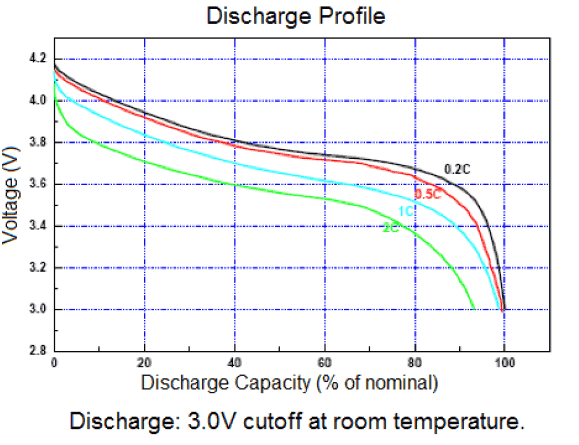
- Sag: higher load pushes the curve lower. That’s the “dip” you see on throttle.
- Rebound: when you back off, voltage jumps up. That’s why a 2-second calm moment gives a better decision number.
- Steep drop near the end: once you get close to the low-3.4V-ish region, voltage can fall quickly and there isn’t much capacity left.
Two Real Scenarios (So You’re Not Guessing)
Scenario 1: FPV / drone — you see 3.5V/cell mid-flight
You punch out, voltage dips, the OSD chirps, and your brain wants to slam a panic landing. The trap is judging the pack by the worst dip.
If rebound comes back clean (say, high-3.6-ish), I’ll usually take one calm line to set up a smooth landing instead of trying to “squeeze one more punch.” If rebound stays low (mid-3.4-ish or lower), I stop pushing and land right away.
Small detail that matters: if it’s cold out, expect worse sag on the first pack. Smooth throttle for the first minute, then judge by rebound.
Scenario 2: RC car / boat — it felt strong, then suddenly felt flat
Cars and boats can pull heavy current for longer stretches. The pack doesn’t always “warn” you politely — it just starts feeling dull: less punch, more heat, and then voltage collapses quicker at the end.
How “time to stop” usually feels on different models
FPV / drones
You usually notice it on the OSD first. The mistake is reacting to the worst dip instead of what the pack does right after the punch-out. A hard dip with a clean rebound still gives you time for a tidy landing. A hard dip with a weak rebound usually means the fun part is over.
RC planes
Planes often give you a little more room because you can back off and still stay in the air. That makes rebound especially useful. If it recovers cleanly, you still have enough for a proper circuit. If it settles low, stop trying to squeeze in one more climb.
RC cars
Cars often feel “soft” before people check the number. Less punch, weaker acceleration out of corners, and a flatter overall feel usually tell you more than one random voltage snapshot.
RC boats
Boats can be deceptive because they may still look quick on the water even when the pack is already near the bottom. Once the pack starts feeling flat, the drop can come quickly, so stopping a little earlier is usually the better call.
Pack Voltage Math (2S / 3S / 4S / 6S / 8S)
Quick formula: pack voltage ≈ per-cell voltage × S. It’s the fastest way to make telemetry feel less mysterious.
| Per Cell | 2S | 3S | 4S | 6S | 8S |
|---|---|---|---|---|---|
| 4.2V (full) | 8.4V | 12.6V | 16.8V | 25.2V | 33.6V |
| 3.8V (storage-ish) | 7.6V | 11.4V | 15.2V | 22.8V | 30.4V |
| 3.5V (late-pack) | 7.0V | 10.5V | 14.0V | 21.0V | 28.0V |
Alternate nominal-filter pages: 2S (7.6V) · 3S (11.4V) · 4S (15.2V) · 6S (22.8V)
Alarms / LVC Without Guessing
There isn’t one perfect alarm number because alarms read under-load voltage, and sag changes with props, weight, gearing, temperature, and pack health. Use alarms as “check now” prompts, then use rebound to decide.
• Set a warning that gets your attention under load (often in the 3.4–3.5V/cell under-load range).
• When it chirps, do the 2-second calm moment and look at rebound.
• If your buzzer screams constantly from sag, raise the warning slightly or rely more on the rebound check + a timer.
It’s not about one magic number — it’s about a repeatable habit that keeps you out of the danger zone.
High Voltage LiPo (LiHV): The 4.35V Note
Some packs are labeled LiHV and are designed to charge higher than standard LiPo (commonly around 4.35V/cell). Only charge to LiHV levels if the pack is clearly labeled LiHV and your charger supports it. If it’s not labeled LiHV, treat 4.2V/cell as the limit.
Capacity vs Sag (2200 / 3300 / 5000)
Capacity doesn’t change the voltage rules. But it often changes how dramatic sag looks under the same demand. Smaller packs pulled hard will usually dip harder than bigger packs doing the same job.
Connectors & Hidden Voltage Loss
A loose/worn plug, undersized connector, or poor solder joint can create voltage drop that looks exactly like a tired pack. A sneaky clue is warmth at the plug or leads.
Storage Voltage
If you’re not using the pack soon, aim for 3.8–3.85V/cell. Packs tend to age more gracefully there than sitting full or near-empty. Most smart chargers include a Storage mode to do this automatically.
• 4.2V/cell is full — early drop is normal.
• 3.7V/cell is a label, not “50% battery.”
• Ugly dips happen under load. Rebound is the useful signal.
• Treat 3.2–3.3V/cell (rebound/resting) as a practical stop line. ~3.0V is a floor, not a goal.
• For overcharge/deep over-discharge, prioritize safety and decide whether to retire — don’t gamble.
FAQ
Category
Category
Acquista i nostri bestseller
 11%
OFF

Avios (PNF) Grand Tundra 2 STOL Sports Plane EPO 1700mm (Green/Silver)
SKU 9499670637
$327.99$369.0018%
OFF
H-King Paramotor V2 con barra luminosa a LED 2400 mm (PNF)
SKU 9310670504
$155.99$189.9913%
OFF
H-King (PNF) Flybeam 2 Night Flyer w/LED Light System 1092mm (EPO)
SKU 9310670554
$156.99$179.9915%
OFF
H-King (PNF) KitFox Sport Plane 1100mm/1250mm (EPO)
SKU 9898670063
$169.99$199.9915%
OFF
Durafly Curtiss P-40 Warhawk V2 "Aleutian Tiger" 1100mm (PNF)
SKU 9306670734
$203.99$239.9915%
OFF
Durafly Tundra V3 "Inspire" (PNF) Modello Sportivo con Flaps Rosso/Argento EPO 1300mm (51")
SKU 9499670588
$211.99$249.0033%
OFF
HobbyKing Sports Hawk "ARF-Plus" Jet EDF 105mm con Retrattori, Servocomandi e Luci LED
SKU 9306670706
$804.99$1,199.0015%
OFF
HobbyKing® ™ Tricheco Aliante w / flap EPO 1.400 millimetri (PNF)
SKU 9306000019
$83.99$98.9920%
OFF
Durafly (PNF) Rare Bear Reno Racer 680mm EPO (Gold/White)
SKU 1021670038
$135.99$169.9920%
OFF
Durafly (PNF) Rare Bear Reno Racer 680mm EPO (Green/White)
SKU 1021670037
$135.99$169.9920%
OFF
Durafly Tundra TPX (PNF) EPP Profile 3D/Aerobatic Plane 1050mm
SKU 1021670039
$143.99$179.99
Turnigy APEX 2200mAh 3S 11.1V 180C LiPo Battery with XT60 for 7 inch FPV Drone and Planes
SKU 9067110092
$19.99$25.99
Turnigy 3300mAh 3S (11.1V) 30C Shorty LiPo Battery Pack w/XT60
SKU 9067110010
$18.99$22.99