Blog
Cerca un articolo
Battery
Educational
Understanding LIPO Battery C Ratings
Battery
Educational
Understanding LIPO Battery C Ratings
This article reflects an older perspective on LiPo C-ratings and battery testing. For a clearer guide to what C-rating means, how to estimate current, and what actually matters in real RC use, read our updated article: LiPo C Rating Explained (What It Means, How Much You Need, and What Actually Matters).
Have you ever wondered about the authenticity of the C rating applied to your shiny new battery pack?
You might be surprised to learn that many manufacturers can be rather generous with battery labels. It’s a vicious cycle because as one vendor slaps on a new number, others often follow. Some claims in the market have been clearly exaggerated, and high printed discharge ratings have long been a source of debate in the RC world. Generally, the C rating should be considered as a guide only.
If you want a more step-by-step explanation of what printed C-ratings really mean, how to estimate current safely, and how to judge a pack in real-world RC use, see our updated guide: LiPo C Rating Explained.
This is because marketing departments can sometimes get a little creative when it comes to discharge claims. The concept of a C rating is to provide consumers with a simple guide to compare one battery against another, which is a great idea. However, in practice, you’ll often find that the minute one vendor releases a 65C battery, their competitor is ready with a 75C label. I’ve seen just that happen, and people in forums quickly assume battery Z must be better simply because it has the bigger number. 
Some may recall when Turnigy launched their very impressive graphene battery packs. The market scrambled to come up with something as good, and some companies opportunistically added the word graphene to battery titles without the underlying product really changing. That kind of label inflation is exactly why experienced hobbyists learn to treat battery numbers with caution.
LiPo battery discharge current is often expressed as a C-rating in order to create a standard measurement to rate one battery against another. C stands for capacity, so as an example if we have a 1000mAh battery that is rated at 1C this means that the battery is rated to discharge a current of 1 amp (1000x1/1000=1). If we have a 5000mAh battery that is rated at 65C this means that the battery is rated to discharge a current of 325 amps (5000x65/1000). Most 5000mAh batteries would be seriously stressed at 100–150 amps and could not realistically supply 325 amps in normal RC use.
Manufacturers can be a little boastful when it comes to battery ratings. Some are better than others, and some claims are clearly more conservative than others. The RC aircraft community has traditionally been quite cautious of manufacturer claims and often relies on independent testing to verify them. In other areas of the hobby, buyers are sometimes more willing to accept the printed number at face value. That’s where a lot of disappointment starts.
Take note of the type of testing some packs are subjected to. It can be more about feels and looks than repeatable measurement. That said, scientific testing can generally be relied upon. Repeatable testing is far more useful than simply saying a pack “feels strong.” Companies with questionable claims often avoid rigorous reviewers because the results may not support the sticker on the pack. Recently the RC community has also seen plenty of favorable reviews tied to affiliate links, so it’s worth thinking carefully about what you are being offered and whether it has a real testing basis behind it.
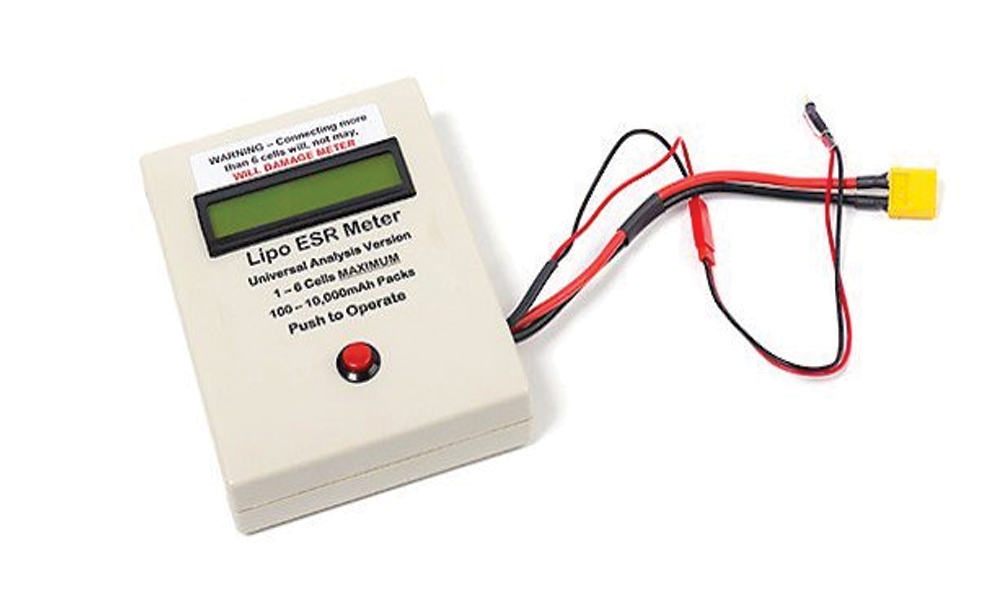
One example often discussed in the community is when very high printed C claims are compared against actual ESR or IR measurements. Using tools like the Wayne Giles ESR meter can quickly expose the gap between a label and real capability. Useful video references that were part of this discussion at the time include: video 1 and video 2.
What makes a good LiPo battery?
Not all batteries are created equal, so in reality, a high C rating is only part of the picture. A good analogy is beer: similar look, similar alcohol content, and even the bottle might look similar—but that’s where it ends. There is much that needs to be considered when determining a good battery from a poor battery. Something as simple as poor soldering can turn what might have been a good battery into a bad one, no matter how good the cells in the pack are.
We cover that in more practical detail in our newer guide, especially the role of internal resistance, voltage sag, heat, wiring, and real-world pack behavior.
What to look for?
- Low internal resistance (verifiable by a Wayne Giles Universal ESR Analysis Meter or similar tool)
- Balance lead wires that are silicon coated so they are less prone to breaking
- A realistic discharge capability, not just a big printed number
- High cycle count (500–1000+ charge/discharge cycles in favorable conditions)
- Reputation for quality
- Good warranty support
- Excellent construction
- Scientific peer review or trustworthy testing
Avoid
- Reviews that focus only on how something feels or looks
- Reviews that avoid a scientific approach to testing
- Deals that sound too good to be true
- Ridiculous claims (for example, extreme printed C figures that don’t line up with real-world testing)
- Illegal shipping (if it damages an aircraft or harms people, you as the importer may be liable)
How is IR used to calculate a genuine C-Rating with a LIPO battery?
There have been a few contenders over time, but the original is still one of the best-known references. The Wayne Giles designed ESR meter is, without doubt, a gold standard in this kind of measurement. Internal Resistance (IR) is an empirical value that describes observed behavior. When used in a normal application such as in an RC model, a LiPo battery behaves as though it were a voltage source in series with a small resistance inside the battery—hence Internal Resistance.
A LiPo is not a perfect voltage source containing an actual resistor. It just behaves as though it was, and that allows us to make some useful predictions about performance. The equations involved and their solution are not for the faint-hearted, so we’ll leave the deeper math to the boffins. We must remember that in reality there is no literal resistor within the battery, so with this in mind we use some resistor rules (for example, two cells in parallel have half the IR of one) but not others, because IR varies dramatically with temperature in a way a normal resistor does not. That is why the Effective Series Resistance (ESR) term is really preferable.
Importantly, IR is a measured number, not an intrinsic property, so a different method of measuring IR can give slightly different numbers.  Other IR measurement methods such as the FMA PL8 charger and iCharger 3010B use the Kelvin method by measuring cell voltage through the balance leads to avoid errors caused by the resistance of the battery leads and connectors. The Hyperion Super Duo historically showed slightly different behavior, although later firmware revisions improved consistency with ESR meter and iCharger results. Results may be close, but not identical, and when comparing IR numbers you can only do so reliably if you know at least the test temperature and the method used. This is very important because temperature has a significant impact on the result.
For beginners, the short version is simpler: treat printed C-rating as a rough filter, then judge real performance by sag, heat, and consistent behavior under load. We explain that more clearly in our updated article here: LiPo C Rating Explained.
Why use IR if it is so prone to measurement variables?
C rating cannot be relied upon completely because manufacturers are known to overinflate. It is largely meaningless unless it is specified under particular conditions—and that almost never happens in a useful way for consumers. Practical experience by knowledgeable hobbyists over several years and in several countries suggests that IR is a good measure provided the device and method used are correct. It is fairly easy to do with the right equipment, and it is easier to understand than many more complicated testing approaches. Practical experience to date has shown it is a good guide to real performance.
What is the importance in practice?
The aim of the Max Current calculator is to give a very simple tool to estimate the maximum current any particular battery is capable of while maintaining a decent cell voltage and limiting internal thermal heating. It is not a purely theoretical tool but one based on years of observation of battery performance and heating under test and in flight. The conclusion is that placing a limit on the power dissipated in the battery as a function of its capacity is a remarkably good guide to the maximum current rating. This has proved true over a range of commonly used battery sizes, down to the tiny single cells used in micro fliers, and hopefully can be extended by others’ experience.
In the end, we all want reliable batteries that will do what they say they will and deliver what they claim. If you want the updated, more practical version of this topic, read our newer guide here: LiPo C Rating Explained (What It Means, How Much You Need, and What Actually Matters).
Enjoy.
Written by gozerian
Hear it First: Join our Mailing List
Sign up to receive new product updates, exclusive discounts, news, and more!
Category
Tags
Category
Tags
Acquista i nostri bestseller

HobbyKing Hall Cherokee V2 1700mm Glider PNF w/ Retractable Propeller
SKU 9310670593
$179.99
Avios Albatross HU-16 USAF Search & Rescue RC Flying Boat PNF 1620mm
SKU 9310670605
$359.99
H-King (PNF) KitFox Sport Plane 1100mm/1250mm (EPO)
SKU 9898670063
$159.36$199.99
Avios Extra NG (PNF) Semi-Scale 3D Aerobatic Airplane EPO 1600mm
SKU 9447670080
$539.99$569.00
HobbyKing Sports Hawk "ARF-Plus" Jet EDF 105mm con Retrattori, Servocomandi e Luci LED
SKU 9306670706
$771.36$939.99
Turnigy 3300mAh 3S (11.1V) 30C Shorty LiPo Battery Pack w/XT60
SKU 9067110010
$18.17$22.99
Turnigy APEX 1500mAh 8S 29.6V 180C LiPo Battery with XT60 for 5 inch FPV Drone and Planes
SKU 9067110083
$36.99$43.99
Turnigy APEX 1800mAh 6S 22.2V 180C LiPo Battery with XT60 for 6 inch FPV Drone and Planes
SKU 9067110086
$29.99$39.99
Turnigy APEX 2200mAh 4S 14.8V 180C LiPo Battery with XT60 for FPV Drone and Planes
SKU 9067110094
$26.32$33.99
Turnigy APEX 2000mAh 4S 14.8V 180C LiPo Battery Dual Pack with XT60 for 7 inch FPV Drone and Planes
SKU 9067110089
$49.99$58.99
XFLY F-35 64mm EDF Jet PNP
SKU 1024670398
$269.99$299.99
Turnigy 8000mAh 4S 14.8V 40C LiPo Battery w/XT90-High Endurance LiPo for RC Cars Plane Boats & Drones
SKU 9067110102
$48.99$60.99
Turnigy High Capacity 16000mAh 6S 20C Lipo Battery w/XT90 - High Endurance LiPo for RC Cars Plane Boats & Drones
SKU 9067110054
$138.99$173.99
Turnigy 42000mAh 6S 22.2V 40C LiPo Battery w/XT90-High Endurance LiPo for RC Cars Plane Boats & Drones
SKU 9067110111
$409.99$455.99